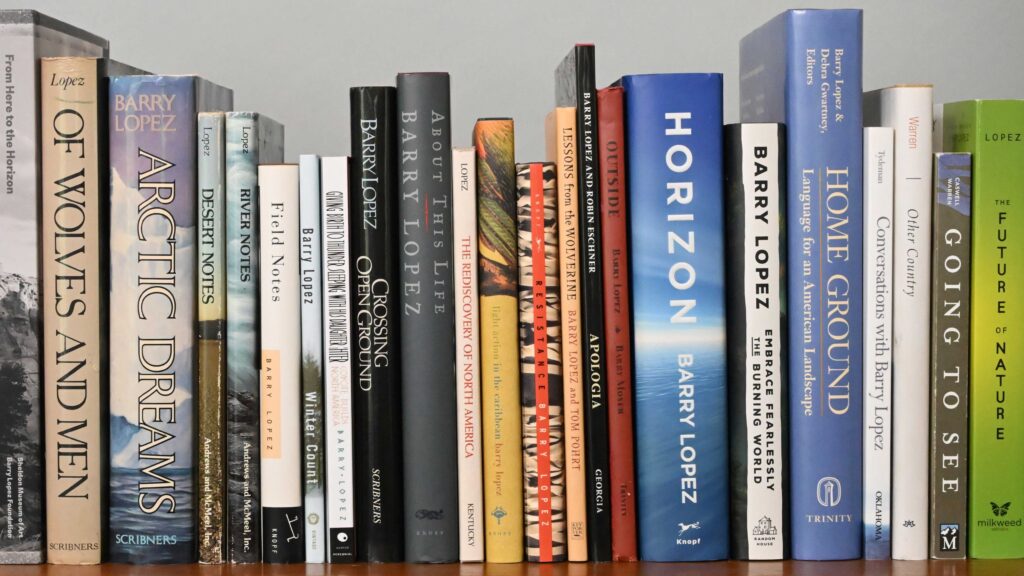
Syntax of the River: The Pattern Which Connects, Barry Lopez in conversation with Julia Martin. Terra Firma Books/Trinity University Press, 2022.
Lopez had no illusions about the seriousness of our global crisis, yet he also felt a deep conviction about the power of hope and the sources of renewal in the living world. Syntax of the River is an extended conversation spanning three days between Lopez and Julia Martin in which he explores what this juxtaposition means for him as a writer.
Horizon. Alfred A. Knopf, 2019.
Horizon is the culmination of four decades of Lopez’s engagement with the worlds’ landscapes, candid analyses of his own history, and dialogues with naturalists, scientists, his readers, and fellow writers. Reflecting on his encounters with six regions of the world—the Pacific Northwest of the United States, the Arctic, the Galápagos Islands, the desert lands of East Africa, Botany Bay in Australia, and the ice shelves of Antarctica—Lopez weaves a series of memories into a philosophical masterpiece that entices the reader into deeper thought about their place on this planet. The overarching theme is our contemporary sense of an impending crisis, which limits our ability to imagine an alternative future. Lopez’s keyword “horizon” seeks to reopen our sense of future possibility through understanding and reimagining the alternatives offered by the many places to which Lopez traveled in the course of his long life.
Home Ground: Language for an American Landscape, edited by Barry Lopez and Debra Gwartney. With an Introduction by Barry Lopez and black-and-white illustrations by Molly O’Halloran, Trinity University Press 2006; paperback edition, Trinity University Press 2013.
Recognizing the loss not only of American landscapes but of the language used to describe the places instrumental to our national identity, Lopez and Gwartney asked 45 American writers and poets to craft definitions of roughly 900 geographical terms, places close to their hearts, in a collective effort to recover local languages of place being erased by social and economic homogenization. Lopez’s introduction is a meditation on the intimate relationship between American language and literature and the distinct character of American places. Contributors include William deBuys, Gretel Ehrlich, Charles Frazier, Robert Hass, Barbara Kingsolver, William Kittredge, Jon Krakauer, Bill McKibben, Ellen Meloy, Pattiann Rogers, Scott Russell Sanders, Kim Stafford, Arthur Sze, Joy Williams, and Terry Tempest Williams.
Related, see From Here to the Horizon: Photographs in Honor of Barry Lopez, edited by Toby Jurovics, with essays by Jurovics, Debra Gwartney and Robert Macfarlane. Barry Lopez Foundation for Art & Environment and Sheldon Museum of Art, 2023.
Exhibition catalogue featuring fifty American landscape photographers whose work is paired with selections from Home Ground. With images by Robert Adams, Virginia Beahan, Barbara Bosworth, Linda Connor, Terry Evans, Frank Gohlke, Emmet Gowin, Mark Klett, Laura McPhee, Mary Peck, Edward Ranney, Mark Ruwedel, and many others.
Apologia, with woodcuts by Robin Eschner. University of Georgia Press, 1998.
In 1989 Lopez drove from Oregon to the University of Notre Dame for a semester as a visiting professor. Along the way, he was deeply troubled by the many carcasses of dead animals on America’s roadways; he began a practice of stopping to remove each one from the roadway, a gesture of respect for a life cut short. This slender volume of woodcuts and prose include tributes to raccoons, garter snakes, birds of all kinds, and pronghorn antelope, injecting curiosity, reverence, grief, and responsibility into the place where the natural world and contemporary life collide.
The Rediscovery of North America. University Press of Kentucky, 1991.
The inaugural Thomas D. Clark Lecture at the University of Kentucky. This reflection on the interplay between people, place, and history reformulates Columbus’s legacy as a self-perpetuating system of annihilation that is evidenced in North America’s desecrated landscapes. His resulting dissatisfaction with living with such a legacy in the country he calls “home” spurs an exploration of the enduring presence of violence and erasure within American social and natural landscapes. As he draws a direct line between the atrocities of Spanish conquistadors and the ongoing pillage of our lands and waters, Lopez calls for the adoption of an ethos that will make further depredations impossible. Doing so, he argues, is a first step toward redemption, which could one day form the basis for non-Native people to make legitimate claims to North America as “home.”
Arctic Dreams: Imagination and Desire in a Northern Landscape. Charles Scribner’s Sons, 1986.
This bestselling exploration of the Far North was recognized with the National Book Award for Nonfiction in 1986. In his groundbreaking classic of natural history, anthropology, and travel writing, Lopez explores the wonders of the perilous Far North, registering the sensations of standing in its strangely stunted forests, beneath the aurora borealis, and looking out onto vastness of its frozen seas. His keen observations of Musk oxen, polar bears, narwhal, and other wildlife provide points of orientation toward life in this place, and toward what it means to be a living being in the late twentieth century. He finds in his fellow humans, from the generations of indigenous peoples and the odd foreign explorers who mostly fell to their doom, the logic to his own drive to move further into these places of otherworldly beauty and perilous enchantment. It is the landscape, he asserts, that shapes the imagination and forges our desires, no matter where on Planet Earth any one of us may find ourselves.
Of Wolves and Men. Charles Scribner’s Sons, 1978.
Lopez’s careful study, a finalist for the National Book award, draws upon an impressive array of literature, history, science, and mythology along with his extensive experience with captive and free-ranging wolves to explore the interaction between this endangered species and human civilizations over the centuries. Instead of making the scientific or moral case for the protection of wolves, Lopez immerses the reader in their sensory worlds. This multi-perspectival view accounts for various ways that humans see wolves, from biologists who view them through data to Inuit hunters who view them as kindred in providing for families. Lopez emphasizes the ultimate unknowability of the minds and lives of wolves, a sensibility based on his own experience raising two wild red wolves. An important catalyst to the emerging field of animality studies, Lopez expands readers’ range ethical choices about how to engage with wolves, and other wildlife, today.