Robert Macfarlane on Barry Lopez and Arctic Dreams
Robert Macfarlane © Bryan Appleyard
Robert Macfarlane is the bestselling author of an award-winning trilogy of books about landscape and the human heart: Mountains of the Mind (2003), The Wild Places (2007), and The Old Ways (2012). He is also the author of Landmarks (2015), Underland (2019), and, most recently, Is a River Alive? (2025), concerning the lives and deaths of rivers and the global Rights of Nature movement. He is a Fellow of Emmanuel College and Professor of Literature and the Environmental Humanities, University of Cambridge, Cambridge, England. A member of the Barry Lopez Foundation’s Advisory Committee, Macfarlane is one of Lopez’s most impassioned and affectionate champions.
Those who have travelled in high mountains will be familiar with the ‘white-out’: the point at which it is impossible to distinguish between snowy land and snowy air. The world dissolves into a single, depthless tone. Perception is confounded. Orientation is difficult. Only verticality remains reliable.
Arctic white-outs are different. In the Arctic, a white-out occurs when there is not too little light, but too much. It happens, Barry Lopez explains, ‘where light travelling in one direction at a certain angle has the same flux, or strength, as light travelling at any angle in any other direction’. The two light streams collide and abolish each other. ‘There are no shadows. Space has no depth. There is no horizon. The bottom of the world disappears. On foot, you stumble about in missed-stair-step fashion.’
Lopez is, unmistakably, one of the most important living writers about landscape and our relations with it – and for Lopez the defining quality of a wild place is that it make us somehow ‘stumble’. It removes a step from our stairs, and thereby draws attention to the ‘narrow impetuosity’ of human schedules. ‘It is precisely because the regimes of light and time in the Arctic are so different,’ he writes, ‘that [it] is able to expose in startling ways the complacency of our thoughts about land in general.’
It is often suggested that we are drawn to wildernesses in order to be healed and consoled. For Lopez, wildernesses are neither therapeutic nor comforting. They are deceptive, and harshly tutelary. His masterpiece Arctic Dreams, first published in 1986, is filled with stories of people whose expectations are bewildered by the polar environment, sometimes fatally. A hunter – his perception of scale confused by the tundra’s plainness – spends an hour stalking a grizzly which turns out to be a marmot. A polar bear grows wings and flies off as a party of men approaches: they have been tracking a snowy owl. Then there is a fata morgana, a mirage of ice and light which simulates a serrated mountainous coastline, and which sometimes cost the lives of nineteenth-century explorers who sailed towards it, hoping for landfall. Native American mythology deified this capacity of the landscape to mislead us as Raven – the trickster god. Lopez understands it chiefly as a function of physics, but he too reveres it for the challenges it poses to our systems of thought and modes of knowing.
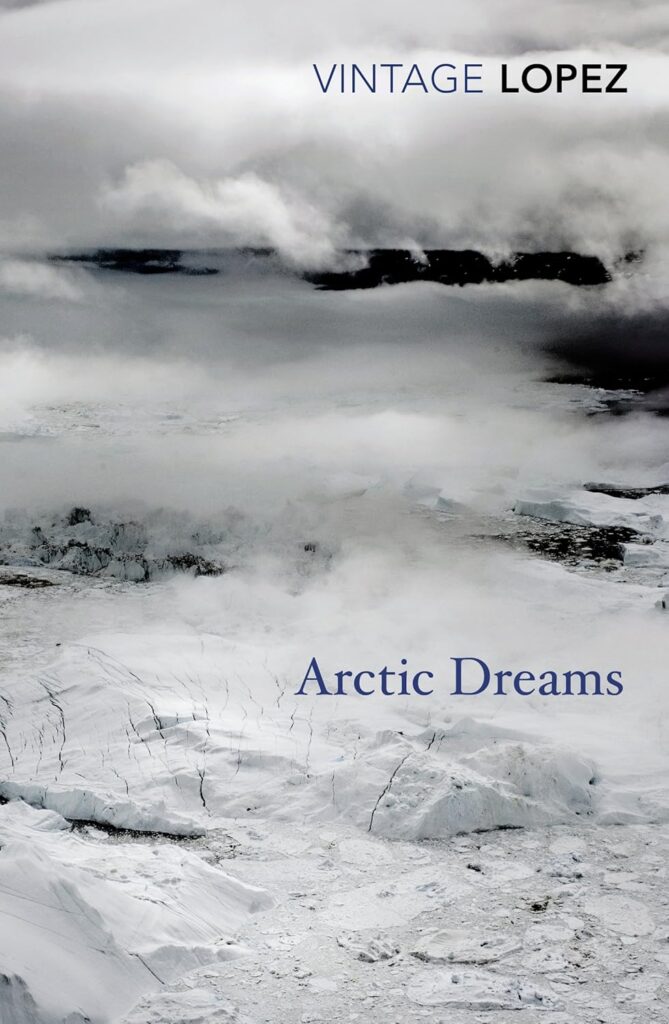
Before writing Arctic Dreams, Lopez travelled for five years in the Canadian north. He passed through the diverse territories of the region: the orange and ochre badlands of Melville Island; the deep-cut canyons of the Hood River; Baffin Bay, where big bergs jostle slowly; and Pingok Island in the Beaufort Sea, where the tides are so slight that ‘it is possible to stand toe-to at the water’s edge and, if one has the patience, see it gain only the heels of one’s boots in six hours’. His sustained contact with these places, and the scrutiny of them required by his research work, brought him to a subtle understanding of the region. It also produced his austerely particular style as a writer. The Artic, Lopez observes, has ‘the classic lines of a desert landscape: spare, balanced, extended, and quiet’ (one notes with admiration the adjectival balance – short-long-long-short – of that second phrase). The same is true of Lopez’s prose. Of all the great modern landscape writers, his style seems most purely to enact the terrain it describes.
When he began to write about the Arctic, Lopez was faced with the problem of purchase. How could language grip a landscape that is so huge and ‘monotonic’? How was he to depict a realm of immensities and repetitions: ‘unrelieved stretches of snow and ice’ and ‘plains of open water’? How was he to bring this stark and enigmatic landscape within the reach of words, without trivialising or compromising it? High latitudes, like high altitudes, are regions to whose surfaces – stone, snow, ice, bright air – words will not easily stick.
What he came to understand was that detail anchors perception in a context of vastness. It is perhaps the defining habit of Lopez’s style to make sudden shifts between the panoramic and the specific. Again and again, he evokes the reach and clarity of an Arctic vista – and then zooms in on the ‘chitinous shell of an insect’ lodged in a tuffet of grass, a glinting tracery of ‘broken spider-webs’, or ‘the bones of a lemming’ whose form resembles that of the ‘strand of staghorn lichen next to them’. The effect for the reader of these abrupt perspectival jumps is exhilarating – as though Lopez has gripped you by the shoulder and pressed his binoculars to your eyes.
Indeed, Lopez rarely travelled without a pair of field glasses looped around his neck. He gives us frequent glimpses of their importance to his vision: ‘I raise my field glasses to draw it nearer,’ he writes of a broad river valley on Banks Island. ‘I bring my glasses up to study again the muskoxen,’ he remarks, so they are ‘clear even at a distance of two or three miles’. ‘I settle myself in a crease in the tundra, out of the wind…and begin to study the far shore with the binoculars.’
What field glasses grant you in focus and reach, they deny you in periphery. To view an object through binoculars is to see it in crisp isolation, encircled by blackness – as though at the end of a tunnel. This isolating effect explains another of Lopez’s signature effects: the single lucid image, gorgeous in its precision – caribou shaking themselves clean of river water in the evening sun such that ‘a bloom of spray…glittered in the air around them like grains of a mica’, or a snow hare that rises up from its form in the tundra, ‘smartly alert…as intent as if someone had whistled’.
Lopez’s astonishingly observant style is born of binoculars; it is born also of the field biologist’s other key technology – the notebook. The origin of his sentences as scribbled notes is clear in his verbless sentences and jabby syntax: ‘The black bowhead with its white chin patches. Walrus on an ice floe. Leads in the spring ice’. Clear, too, in the dazzling immediacy of the book’s present-tense passages, which feel as if they have been transferred without revision from life to journal to published page.
Arctic Dreams is surprisingly concerned with the limits of rationalism. True, its cargo of data is massive – you will find here explanations of the crystallography of frazil ice, or the thermodynamics of polar-bear hair, which are miracles of devout concision. But for Lopez, such information never solves or summarises the Arctic and its creatures; rather, it deepens their ‘mystery’ – a word he is refreshingly unafraid to use. Science finesses the real into greater marvelousness, while lacking total explanatory power. ‘I became’ – Lopez would later remember – ‘one who travels and one who focuses, to be succinct, mostly on what logical positivists sweep aside’.
In 1997, the summer I turned twenty-one, I spent several weeks in the northwest Canada, climbing in the Rockies and hiking the wilderness trails of the Pacific Rim. I was alone for long periods of time, with many hours to kill in tents, so I got through a lot of books. Whenever I came back to cities between trips, I would head for the nearest bookstore to re-stock. I was browsing shelves in Vancouver when I found a copy of Arctic Dreams. There were good reasons not to buy it. I had never heard of Lopez. Its subtitle – ‘Imagination and Desire In A Northern Landscape’ – struck me then as Mills and Boony. It was expensive for my budget. Above all it was heavy: almost 500 pages long and printed on thick paper. Because I had to carry everything I read, I’d taken to assessing my books according to pemmican logic: maximum intellectual calorie content per ounce.
For some now-irretrievable reason I disregarded these objections, bought the book, and read it while I walked the Pacific Rim trail on the west coast of Vancouver Island, camping on surf-crashed beaches, and suspending my food from trees away from my tent in compliance with the bear-safety code. I read it then, and it amazed me. I read it again, lost my copy somewhere near Banff, bought another copy, gave it to my father as a present, borrowed it back off him, and read it again, and again, and again. I still have that copy (with a red-ink inscription from me to my father, dated 18 August 1997): the spine is cracked, the uppers ripped, the margins dense with annotations, and the pages are held together with sellotape, now brown.
Arctic Dreams changed the course of my life, for it turned me into a writer. Its combination of natural science, anthropology, cultural history, philosophy, reportage and lyrical observation revealed to me that non-fiction could be as experimental in form and beautiful in its language as any novel. Its thrillingly faceted style proved to me that prose lyricism was a function of precision – or what Robert Lowell called the ’grace of accuracy‘. Its gyres outwards from the phenomenal to the philosophical showed me how to relate first-hand experience to broader questions of place-consciousness. The other lesson Lopez taught me – though it would take me longer to understand it – was that while writing about landscape often begins in the aesthetic, it must always tend to the ethical. Lopez’s intense attentiveness was, I came later to realize, a form of moral gaze, born of his belief that if we attend more closely to something then we are less likely to act selfishly towards it. To exercise a care of attention towards a place – as towards a person – is to achieve a sympathetic intimacy with it.
After returning from Canada I read more of Lopez’s non-fiction – Of Wolves and Men (1978), his lapidary essay collections, Crossing Open Ground (1988) and About This Life (1998) – and to explore his fiction. It was under his powerful influence that I began work in 2000 on my first book, Mountains of the Mind, about our fascination for high country. I was teaching in Beijing at the time, living in a foreigners’ block on the campus of a university. Every morning at 6am sharp an elderly Chinese man would perform his qigong exercises outside the window of my study-room, wielding a sword with a silver blade, from whose hilt whirled green silk tassles. On the bookshelf above the bare desk at which I wrote was an anthology of mountain-writing from Petrarch through to Mallory – and a copy of Arctic Dreams.
I was not, of course, the first to fall under Lopez’s spell or to recognise his brilliance. In North America, Lopez is a canonical figure, held in respect tending to reverence by readers and critics. Arctic Dreams won the American Book Award, and stayed on the New York Times bestseller list for months. His writing is the subject of countless academic dissertations, book chapters and critical studies, and at the many universities where ‘nature writing’ is studied or practiced, his books are syllabus staples.
Lopez himself is rightly uneasy about being labelled a ‘nature writer’, a term he uses only within the tweezers of inverted commas. It is a label that drastically limits his formal range as a writer (spanning essays, short stories, novels, and polemics, as well as the gloriously mixed mode of Arctic Dreams), and which disregards his work as an editor, lecturer, conservationist, photographer and humanitarian campaigner. It is more helpful to position him in terms of other writers with whom he shares values or craft: the transcendentalist trio of Emerson, Thoreau, Muir (a vision of wild landscape as spiritually edifying); the Melville of Moby-Dick (encyclopaedic
fact-gathering); Rachel Carson and Loren Eiseley (the mingling of rhapsody and science; Willa Cather, John Steinbeck and William Faulkner (the assumption that the fates of humanity and nature are inseparable); Peter Matthiessen, Wendell Berry and Wallace Stegner (an explicitly dubious view of technological progress, even of capitalism); the poetry of W.S. Merwin, Amy Clampitt and Gary Snyder (crystalline lyric imagery); the essays of John McPhee and Joseph Mitchell (an elegant conscientiousness of reportage); and the political commitment both to beauty and to social justice of Rebecca Solnit. Any such positioning would also have to take account of his sustained engagement with the cultures and literatures of indigenous peoples, to whose thought Lopez has repeatedly turned in search of wisdom, and models of a human identity that exceed nationalism and material wealth. In common with all these writers, Lopez sees landscape not as a static diorama against which human action occurs, but rather as an active and shaping force in our imagination, our ethics, and our relations with each other and with the world. To Lopez, geography is inextricable from morality.
Thus his repeated suggestion that certain landscapes are capable of bestowing a grace upon those who pass through them or live within them. The stern curve of a mountain slope, a nest of wet stones on a beach, the bent trunk of a wind-blown tree: such forms can call out in us a goodness we might not have known we possessed. ‘In a winter-hammered landscape,’ he writes, ‘the light creates a feeling of compassion…it is possible to imagine a stifling ignorance falling away from us’. The Arctic is, to Lopez, especially powerful in this regard. It causes us – as Thoreau put it – ‘to witness our own limits transgressed’. It induces humility in us. One of the qualities of the Arctic he most reveres is the clarity of its dustless and ‘wind-washed’ air, in which sunlight renders objects ‘with…unusual sharpness’. He writes of the Arctic’s ‘perpetual light and unobstructed view’ (recalling John Ruskin’s delicate phrase about the ‘endless perspicuity of space; the unfatigued veracity of eternal light’), and it is obvious that for Lopez this lucidity has a spiritual correspondence. In air of such ‘depthless clarity’ it is not only the ‘country which stands revealed’, but also the minds of those humans who move within it. In the arctic, we see more clearly – out across the landscape, but also back into ourselves.
Lopez practices a topographic humanism, then; and he is a postmodern devout, secular in principle but drawn to mysticism. His prose – priestly, intense, grace-noted – carries the hushed insistence of the sermon, driven by the belief that ‘it is possible to live wisely on the land, and to live well’. Irony and ambiguity are rarely part of his repertoire. His is an unshadowed style, ‘transparent as a polished windowpane’ as he puts it.
For some readers, it is all too much. Jonathan Raban – in his fine book of the Canadian north, Passage to Juneau – describes trying to read Arctic Dreams but setting it aside, feeling indicted. ‘I found myself,’ he wrote, ‘an agnostic in his church; embarrassed, half-admiring, unable to genuflect in the right places…aching for more profane company’. Raban’s reaction is understandable. But Lopez’s sincerity is worth the price. The Arctic—for all its autonomy, its salutary wildness – has become damagingly bound into the schedules of late capitalism. Arctic Dreams was first published almost thirty years ago. Climate change is now causing Arctic summer sea ice to deplete at record rates, intensifying the steady decline in coverage that is conventionally dated back to 1979. The US Navy recently predicted that the Arctic would be ice-free by 2016. As the ice dissipates, so industry gears up. The Arctic is the new frontier for energy procurement. Gazprom is siting rigs above the Arctic Circle, and starting to drill. The Northwest Passage is open to container ships. The oil and gas extractive industries (on which we all depend) and global shipping (from which we all benefit) are moving north. The loss of the sea ice, and the consequent arrival of infrastructure, pose huge threats to the biodiversity about which Lopez writes with such rapt and inspiring wonder.
So it is that this magnificent book, composed as a celebration of the polar landscape, might well outlive its subject and become its elegy. Seen in this light, Lopez’s graceful spiritualism – his drive to reconnect the cultural and the natural – looks less like piety and more like activism. As he has remarked elsewhere, the environmental predicament in which we now find ourselves ‘calls on our collective imaginations with an urgency we’ve never known before. We are in need not just of another kind of logic, another way of knowing. We need a radically different philosophical sensibility’. Lopez’s astonishing work advances that sensibility, and I am in awe of it.
Robert Macfarlane, “Introduction,” Arctic Dreams (Vintage Books, London, 2014, xi – xviii).